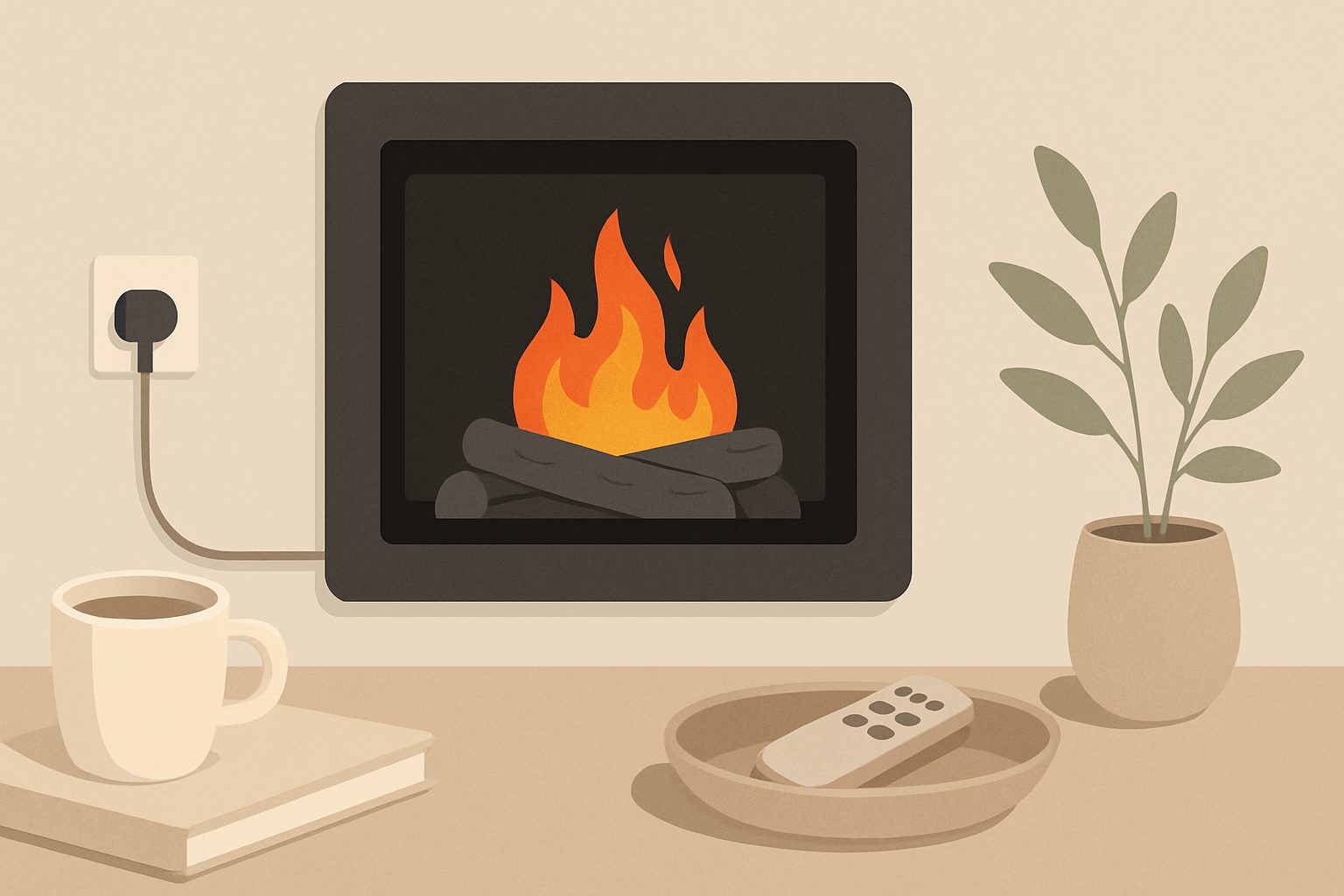
Best Electric Fire Inserts for Existing Chimney Breasts UK
If you've got a working chimney breast but no interest in dealing with flues, chimney sweeps, or burning logs, an electric fire insert is a straightforward retrofit option. Unlike full fireplace builds, inserts slot into your existing opening—provided the dimensions line up. Here's what you actually need to know about sizing, installation, and whether one will work in your space.
Why inserts make sense for existing fireplaces
A chimney breast is already there, the opening is built, and the aesthetics are settled. An insert cuts out the guesswork: you're not redesigning the whole wall. You measure, pick a compatible unit, and install it into the existing frame. For most UK homes with standard openings (typically 750–900 mm wide), ready-made inserts come sized to fit. That's the appeal.
The catch is that "existing fireplace" varies wildly. Some openings have old cast iron surrounds that need careful handling; others have been stripped back to brick. Back-boiler complications are common in older properties. Getting these details right upfront saves frustration later.
Standard UK fireplace dimensions
Most conventional fireplaces in UK homes sit within one of a few predictable ranges. A standard opening (the hole itself) is usually 750 mm wide by 600–700 mm tall. This is the measurement that matters for an insert—not the surround width, which can be larger.
Before ordering, measure three points across the opening: top, middle, and bottom. Chimney breasts rarely sit perfectly plumb; if there's more than 10–15 mm variance, you may need adjustment work, which complicates fitting. Measure depth too. Your insert needs clearance behind it; the brick chimney back doesn't need to be pristine, but it should be reasonably flat so the insert sits flush.
Most quality electric inserts come in 700 mm, 750 mm, and 800 mm widths. Depth clearance behind the facia is usually 100–150 mm for the insert body itself, plus room for plasterboard, skirting, or trim. If your chimney projects into the room (which many do), you're working with what exists.
Depth clearance and back-boiler removal
Here's where existing fireplaces throw a curveball: older properties often have back-boilers fitted into the chimney breast. These are small heating appliances tucked in behind the original fireplace, connected to the central heating. Before you measure for anything, establish whether one is present.
If there is a back-boiler:
- It must be disconnected and removed first. This isn't a DIY job—an engineer needs to drain the system, isolate it, and cap off the pipework. Expect £150–300 for this alone, depending on how corroded it is and how accessible.
- Once removed, the space opens up. You'll have more room behind the insert, which is useful. The cavity becomes accessible for new plasterboard or fire-back repair if needed.
- Never leave a back-boiler in place and work around it. It's a safety issue and creates a dead air space that can cause problems later.
This is a common reason why retrofit costs climb: the removal work isn't always obvious until a surveyor or installer attends.
Electrician costs and installation labour
An electric insert is simpler to install than a gas stove, but it's not a flat-pack job. You're dealing with electrics, and in most cases, a qualified electrician should fit it.
What's involved:
- Supply cable: Most inserts need a 13 A plug, which means an ordinary wall socket nearby. Some larger models require a fused spur (a dedicated outlet). If your socket is far away or blocked by the chimney, running new cable in or near the chimney breast is additional work—budget £100–200 for this.
- Fitting: An experienced installer familiar with fireplaces will measure, check clearances, make good plasterwork around the frame, and ensure the insert is level and secure. This usually takes 2–4 hours.
- Labour cost: Expect £150–300, depending on location and whether the opening needs prep work (removing old rubble, repairing brick, fitting a new fire-back).
Total: insert cost plus £250–500 in labour and electrician fees on a straightforward job. Add another £150–300 if back-boiler removal is needed. It's not massive, but it's not nothing.
What to look for when choosing an insert
Facia fit: The decorative frame that sits flush against the wall. Check it's sized to your opening dimensions and that the overall width (including frame) will sit properly. Some inserts have adjustable trim, which is useful if your opening is slightly irregular.
Depth: Confirm the total depth of the unit. If your chimney breast is shallow (under 300 mm deep), some inserts will stick out into the room. Measure twice.
Heat output: Electric inserts range from 1–2 kW. In a modest lounge, even 1 kW provides noticeable warmth as a supplementary heat source. It won't heat a whole house, but it's fine as an accent.
Build quality: Stainless steel surrounds last longer than painted finishes in a damp chimney environment. Look for units with solid construction, not flimsy frames.
Flame effect: This is subjective. Most modern inserts have LED flame animation. Some look surprisingly convincing; others look like a video screen. View examples in person if possible.
Getting it right
The practical path: measure your opening, establish whether a back-boiler exists (ask a surveyor or the current owner if buying), budget for removal if needed, and choose an insert sized to fit. Get a quote from an installer who's done similar work—they'll spot complications you'd miss. In most cases, a compatible insert will fit an existing UK chimney breast without major headaches.
More options
- Electric Fireplaces – Amazon UK General Category (Amazon UK)
- Dimplex Electric Fires – Amazon UK (Amazon UK)
- Wall-Mounted Electric Fires – Amazon UK (Amazon UK)
- Electric Fireplace Suites – Amazon UK (Amazon UK)
- Freestanding Electric Stove Fires – Amazon UK (Amazon UK)